

Clinical efficacy is established in selected patients. But are we identifying the patients who could benefit?
For years, the central question surrounding biologics in chronic obstructive pulmonary disease (COPD) was scientific: could targeted immunology impact COPD management after a series of mixed or disappointing development results?
The situation evolved and Dupilumab became the first biologic approved for COPD in 2024, followed by mepolizumab in 2025 in the United States. Pivotal trials have shown that targeted therapies can reduce exacerbations in carefully selected populations. But clinical success introduces a different challenge: identifying which patients should be assessed, which meet evidence-based treatment criteria, and which ultimately receive therapy.
Although clinical trials have demonstrated benefits in certain patient populations, real-world practice may differ, making it challenging to identify patients who are eligible for biologic therapies
Asthma showed what is possible. COPD reveals what is difficult.
Severe asthma offers a useful precedent: biomarker assessment, phenotyping and specialist assessment have become increasingly important to biologic selection. COPD is not, however, simply following the same path. Its clinical heterogeneity, smoking-related disease burden, comorbidities and variable care pathways complicate patient assessment and escalation.
In the BOREAS and NOTUS studies, dupilumab reduced moderate-to-severe exacerbations in patients with COPD and type 2 inflammation. MATINEE demonstrated an exacerbation benefit for mepolizumab in an eosinophilic COPD population, although not every symptom or quality-of-life outcome improved significantly. GOLD 2026 reflects the growing role of biologics in selected patients while retaining the importance of optimized inhaled treatment, exacerbation management and iterative blood eosinophils count. [1–4]
The clinical question is therefore no longer simply whether biologics work. It is how reliably everyday care can identify the patients that are most likely to benefit from these new treatments.
Uncontrolled does not mean biologic-eligible
The first biologics approved for COPD require an elevated eosinophil count and a history of exacerbations as a key criteria for treatment selection. Yet patients who continue to experience disease burden despite advanced maintenance therapy represent a broader and more heterogeneous group.
APLUSA Therapy Intelligence COPD illustrates the distinction: 82% in the US (n=50) and 68% in Germany (n=114) of patients with inhaled triple-therapy (ICS, LABA and LAMA) had eosinophil counts below 300 cells/µL. [5]
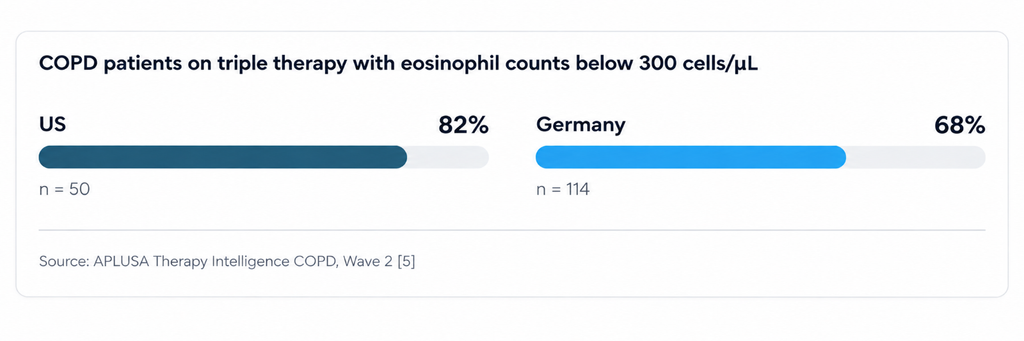
These percentages describe selected patient profiles at a specific time point, not current biomarker status, national prevalence or the proportion ineligible for every biologic. A single historical eosinophil measurement cannot substitute the complete clinical assessment required for treatment decisions.
The strategic implications are nevertheless important: patients with uncontrolled COPD do not necessarily overlap with those eligible for a particular biologic. Similarly, the presence of an unmet medical need in patients below a given biomarker threshold does not demonstrate that an investigational treatment will be effective in this population.
The future market may not simply be larger than today’s eligible population. It may be defined differently.
Phase III development is testing the boundaries of patient selection
Different biological targets are being investigated in different types of COPD populations. Alongside IL-4/IL-13 and IL-5 pathway inhibition, IL-33-directed approaches are exploring whether benefit can be demonstrated in populations defined differently from the initial eosinophilic pivotal programmes.
Published Phase III OBERON and TITANIA findings with tozorakimab support exacerbation reduction in populations, not defined by the previously established minimum eosinophil threshold as the dupilumab and mepolizumab pivotal trials. This should not be interpreted as proof of uniform efficacy across every eosinophil stratum or as an indication for use outside regulatory approval. Other biologic programmes have yielded mixed results, underscoring the need to evaluate each mechanism and trial population on its own terms. [6]
For industry decision-makers, the key question is not which mechanism has the broadest theoretical reach, but which clinically recognizable populations are supported by robust, reproducible evidence, and how these patients can be reliably identified in real-world clinical practice.
The implementation gap begins before prescribing
Even when a patient has persistent exacerbations, treatment initiation is not automatic. Clinicians must confirm disease burden, review adherence and inhaler technique, optimize existing therapy, assess relevant biomarkers and comorbidities, and consider the appropriate referral or escalation pathway.
In APLUSA Therapy Intelligence COPD, physicians cited failure to meet perceived biologic eligibility criteria as a reason for non-prescribing in 40% of relevant US uncontrolled-patient profiles (n=84) and 51% in Germany (n=155). [5] These are physician-reported reasons in selected cases, not an independent adjudication of clinical eligibility, nor evidence that these patients should have received a biologic.
The distinction is consequential. Some patients are appropriately excluded by evidence-based criteria; others may not have completed the assessment needed to establish eligibility. Patient preference, smoking status, reimbursement and referral practices can further shape the pathway.
The next frontier is understanding not only who qualifies, but why appropriate evaluation and treatment do, or do not, happen and how we can improve overall management.
The question the industry should be asking
COPD has entered the biologics era, but its precision-medicine framework is still evolving. New trial evidence may refine the definition of a treatable population; clinical practice will determine whether eligible patients are recognized and supported through appropriate assessment.
For pharmaceutical leaders, three questions now belong together: where is uncontrolled disease concentrated, which patient characteristics are supported by treatment evidence, and what explains the gap between eligibility and actual care?
APLUSA Therapy Intelligence can help examine these questions through physician-reported patient profiles and treatment decisions across healthcare systems, without confusing unmet need, clinical eligibility and prescribing behavior.
The next chapter of COPD biologics may be defined not only by the therapies that emerge, but by the patients we learn to recognize.
Research note and selected sources
[5] APLUSA Therapy Intelligence COPD, Wave 2: 75 US and 50 German pulmonologists; fieldwork 26 November 2025–5 January 2026; physician-reported patient record forms. Uncontrolled triple-therapy subgroup; eosinophil percentages restricted to records with available values at treatment initiation. Selected samples; findings are descriptive and not nationally representative.
[1] GOLD. Global Strategy for Prevention, Diagnosis and Management of COPD: 2026 Report. goldcopd.org.
[2] Bhatt SP et al. Dupilumab for COPD with Type 2 Inflammation Indicated by Eosinophil Counts. N Engl J Med. 2023. doi:10.1056/NEJMoa2303951.
[3] Bhatt SP et al. Dupilumab for COPD with Blood Eosinophil Evidence of Type 2 Inflammation. N Engl J Med. 2024. doi:10.1056/NEJMoa2401304.
[4] Sciurba FC et al. Mepolizumab to Prevent Exacerbations of COPD with an Eosinophilic Phenotype. N Engl J Med. 2025. doi:10.1056/NEJMoa2413181.
[6] Tozorakimab Phase III OBERON/TITANIA publication. N Engl J Med. 2026. doi:10.1056/NEJMoa2606998.