
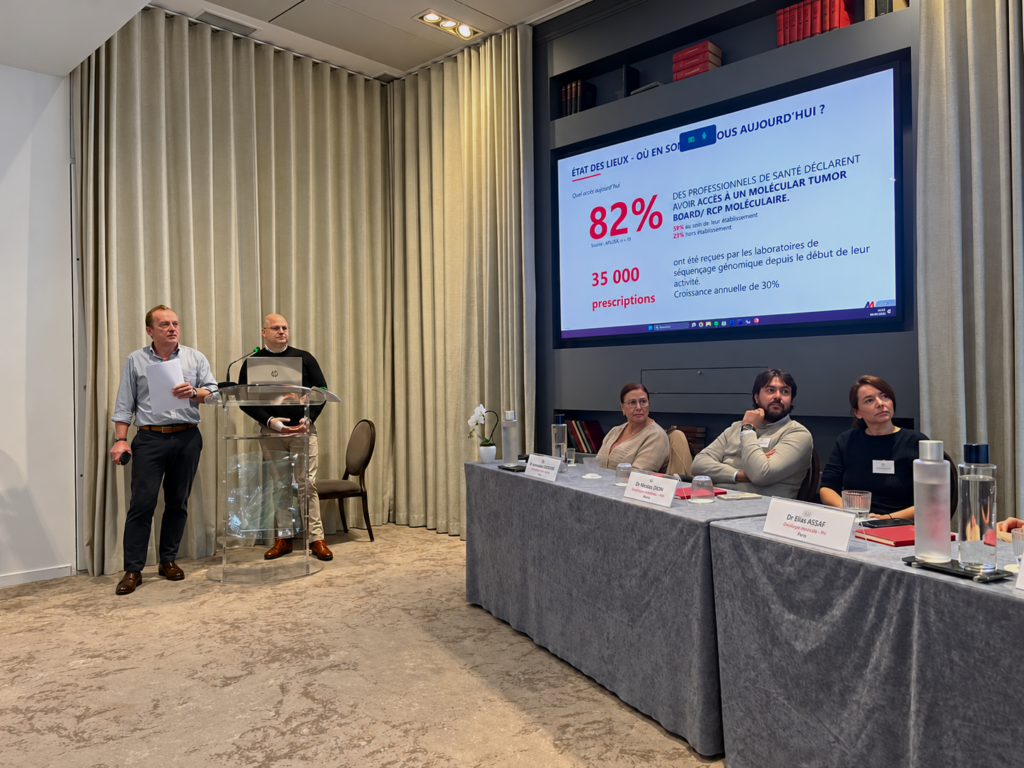
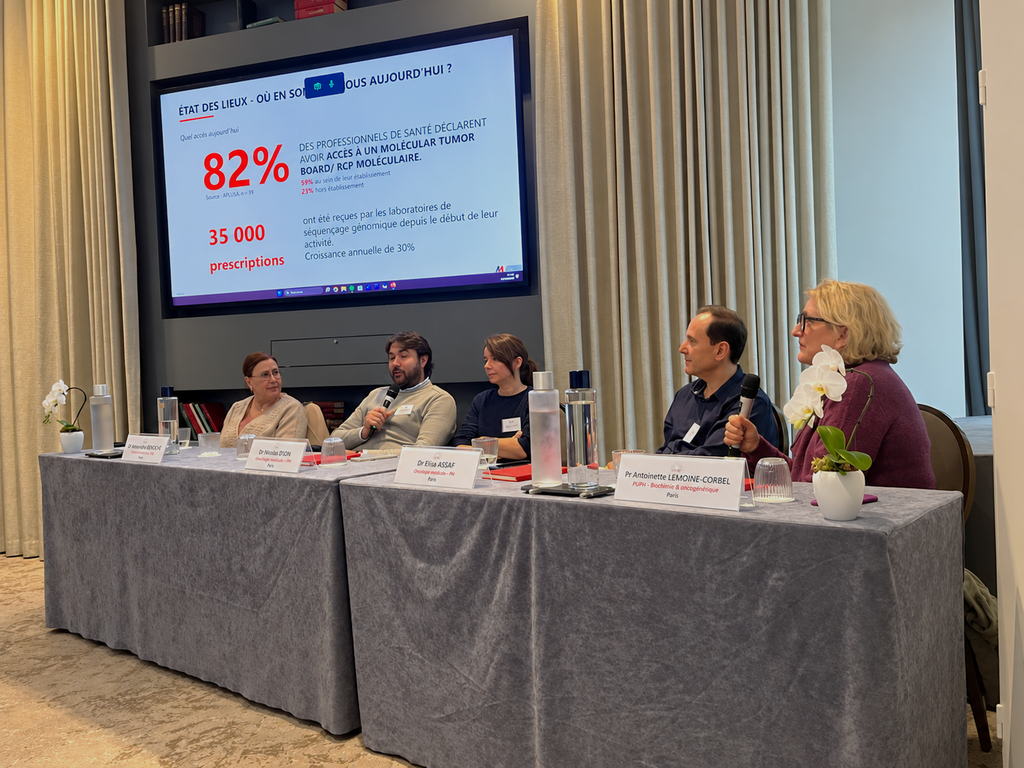
At the APLUSA Oncology Breakfast Briefing on October 9, 2026, discussions among experts highlighted a profound transformation in clinical decision-making pathways. Genomics is enriching cancer care, while the organization of specialist expertise, access to innovation and the conditions required to implement artificial intelligence are becoming increasingly important.
For pharmaceutical companies, this evolution raises practical questions: which biomarkers genuinely inform clinical decisions? How do patients gain access to Molecular Tumor Boards and testing? And under what conditions can new technologies become part of routine clinical practice?
Precision medicine: increasingly multidisciplinary treatment decisions
The growing importance of molecular data does not eliminate traditional clinical approaches. Instead, it is changing how different areas of expertise complement one another and how decisions are made.
1. Precision medicine complements, rather than replaces, tumor-specific care
Molecular profiling enriches treatment decisions, but tumor-specific multidisciplinary tumor boards remain essential. Molecular Tumor Boards (MTBs) are particularly relevant in complex cases or when standard treatment options are limited. Decision-making combines histology, biomarkers, clinical context and multidisciplinary expertise.
2. Improving access to Molecular Tumor Boards requires better regional coordination
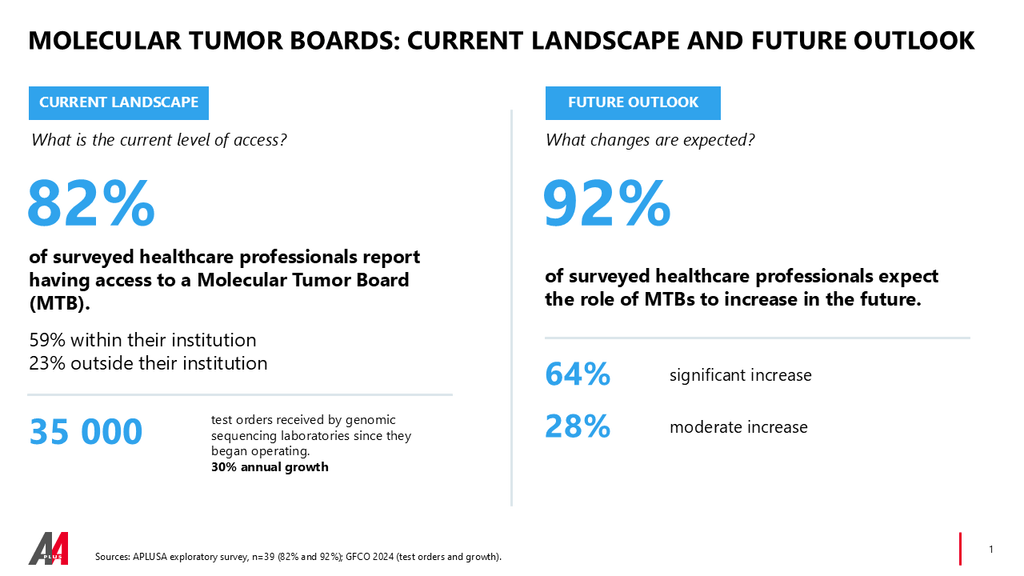
The challenge is not simply to have platforms and experts available. Hospitals outside specialist centers must also be able to access them effectively. Discussions highlighted the value of networks of expert centers, sharing tissue samples and data, and remote multidisciplinary case discussions, while avoiding costly fragmentation of resources and expertise.
3. Identifying a molecular alteration does not guarantee a treatment option
Genomic panels can identify multiple alterations, but not all are actionable. The challenge is to determine which have clinical and predictive relevance in the context of the patient’s tumor, and then connect them to an accessible treatment or clinical trial.
4. Decision-making is more collaborative, but remains clinical and individualized
Molecular biologists, pathologists, oncologists and other specialists all contribute to interpretation. Treatment selection must still account for the patient’s clinical condition, previous therapies, potential toxicities and preferences.
Testing and access to care: making precision medicine a reality
Advances in diagnostics and treatment translate into benefits for patients only when testing, specialist expertise and therapies are accessible within care pathways.
5. Funding and reimbursement can hinder the translation of innovation into care
Discussions highlighted pressures surrounding the funding of molecular testing, reimbursement mechanisms and differences in resources between institutions. The clinical potential of a test or treatment does not guarantee access in practice. For pharmaceutical companies, these issues encompass companion diagnostics, access pathways and value demonstration.
6. Rethinking testing strategies: panel relevance and complementary biopsy approaches
Expanding next-generation sequencing (NGS) panels does not automatically lead to more clinically useful decisions. Testing strategies must balance the biomarkers required for routine care, broader analyses for complex cases and the choice of specimen. Liquid biopsy can facilitate or accelerate certain investigations, but it does not replace tissue biopsy or histopathological diagnosis. The two approaches have complementary strengths and limitations.
Artificial intelligence in oncology: practical applications and persistent barriers
Digital pathology creates new opportunities for AI. However, discussions also highlighted the scale of investment required, validation requirements and questions of trust.
7. AI is already helping standardize certain pathology assessments
Digitizing pathology slides enables tools for biomarker quantification, particularly Ki-67, as well as ongoing developments involving PD-L1. Such tools may improve reproducibility and facilitate collaboration between centers, provided that human oversight and quality assurance procedures remain in place.
8. AI-based biomarker prediction is promising, but requires validation
Researchers are exploring models that infer certain molecular characteristics from histopathology images. It is essential to distinguish routine applications from experimental tools: retrospective performance alone is insufficient to support treatment decisions without appropriate clinical validation.
9. Cost and data storage constrain the scalability of AI
Digitization infrastructure, scanners, servers, software and cybersecurity require substantial investment. One example shared at the event involved approximately 1 GB per digitized slide and 1,000 slides scanned per day at the laboratory described. Digital images are retained for three months unless specifically selected for longer-term storage; physical slides and tissue blocks remain archived. This local policy illustrates the trade-offs between cost, data availability and research potential, rather than representing a nationwide standard.
10. Without confidence in AI outputs, workload reductions remain limited
A pathologist emphasized the risk of false negatives, particularly in detecting lymph node micrometastases. If every negative result still requires manual review, the operational benefit is limited. Adoption requires robust validation, a clear understanding of performance in the intended patient populations, traceability of results and the ability of healthcare professionals to challenge algorithmic outputs.
11. Preserving human expertise is becoming a training priority
Automation can support clinical decisions without replacing medical interpretation. Speakers warned of the risk of overreliance on tools and emphasized the importance of maintaining the expertise needed to identify errors or inconsistent findings.
What does this mean for pharmaceutical companies?
Beyond clinical considerations, discussions and attendee feedback revealed differing needs across companies and healthcare institutions.
Widely varying levels of familiarity with genomic platforms
Discussions revealed different levels of familiarity with genomic platforms. Some participants had already attended several conferences on the subject, while others were only beginning to understand how these platforms operate. This qualitative observation suggests a need for educational approaches tailored to different teams and organizations; it is not a representative measure of the market.
A resource gap between specialist centers and regional hospitals
Discussions illustrated differences in resources and investment capacity. The challenge is therefore not solely scientific: care pathway organization, referral to expert centers and financial sustainability all shape patients’ actual access to precision medicine.
A clear need for guidance on market access
Discussions also revealed interest in MTBs alongside a need for greater clarity on test funding, reimbursement, timelines for access and implications for treatment strategies. These issues connect an understanding of clinical practice with patient pathways and market access.
A transformation that goes beyond technological innovation
A consistent theme emerged from the briefing: precision medicine is transforming the entire decision-making pathway, from data generation and interpretation to effective access to treatment. For pharmaceutical stakeholders, understanding this pathway, and the gap between scientific potential and real-world practice, is becoming essential to supporting the evolution of oncology care.
This article summarizes key insights from discussions at the APLUSA Oncology Breakfast Briefing on October 9, 2026. Observations attributed to speakers reflect the practices and perspectives presented during the event.